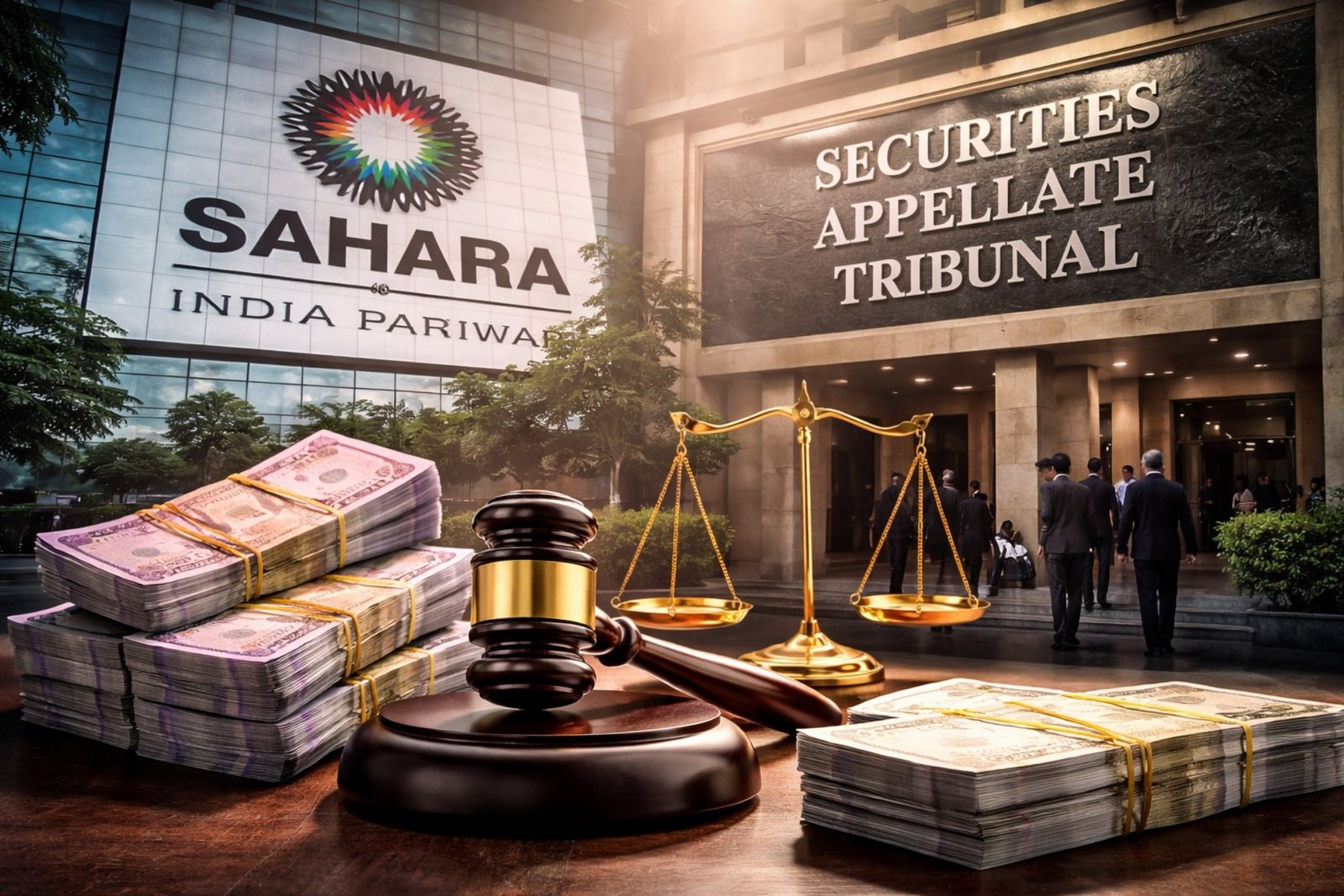
People use their money that they earned hard and depend on companies to obey the rules and not to ruin their interests. Sahara Group In a significant twist that has once again put Sahara Group case into limelight, the Securities Appellate Tribunal (SAT) has supported a significant order passed by the Securities and Exchange Board of India (SEBI).
The decision orders Sahara India Commercial Corporation Ltd (SICCL) and its directors to repay approximately 14, 106 crore that it had raised out of approximately two crore investors in the form of optionally fully convertible debentures (OFCDs).
Sahara Group This ruling enhances the powers of SEBI in defending investors and to see that companies adhere to correct securities laws in raising money in the market.
The implication of the SAT Ruling on Sahara Group.

The Securities Appellate Tribunal rejected the appeals made by Sahara India Commercial Corporation Ltd, Sahara India and some of the directors of the company. These appeals were a challenge to an earlier decision of SEBI dated October 31, 2018.
The tribunal stated that Sahara India commercial corporation Ltd had solicited funds totaling Sahara Group approximately 1.98 crore investors between July 1998 and June 2008 through optionally fully convertible debentures.
The tribunal determined that an activity of such a scale fundraising was obviously a public issue. Due to the fact that the offer was sent to a much greater number of investors than would have been permitted through legal limits of a privately made placement, the company had to adhere to some of the strict regulatory procedures.
These involved seeking clearances by SEBI and issue listing on known stock markets. The company, however, was incapable of fulfilling these requirements, and hence, the fundraising exercise was a contravention of securities laws.
The Reason the Fundraising should have been viewed as a Public Issue.
According to the tribunal, the Companies Act, 1956, contained a provision that, 50 and more people had to be offered after which the offer was to be regarded as a public offer. Public offers should meet all types of disclosure regulations and regulatory authorizations that aim to safeguard investors.
The number of people to whom the debentures were issued by Sahara was over 1.98 crore in this case. This is quite an excessive figure. Sahara Group Consequently, the tribunal found the company not to be able to consider the issue as a private placement or a domestic arrangement.
This gave full powers to the regulator to intervene and take the enforcement action since Sahara had failed to seek permissions of the stock exchanges and required approvals of SEBI.
SEBI Delay Argument Rejected by SAT.
The second point that Sahara used to justify their action was that SEBI had waited too long to file a suit. This claim was however rejected by the tribunal.
SAT noted that the investigation was initiated by SEBI which had reviewed matters of other companies of the Sahara group and also on the basis of an inspection report by the Ministry of Corporate Affairs.
Taking into account the size of the case and the reality that it classic had the largest number of investors of around two crore and a substantial number of documents, the tribunal found the time taken by SEBI to be fair.
Sahara Group The tribunal highlighted that complicated financial cases usually need thorough research before a regulatory measure can be undertaken.
Effect of the Decision on the Investors and Market Regulation.
The importance of this ruling is that it supports the need to keep the financial markets in India transparent and compliant with regulation. The tribunal has ensured that companies do not evade securities laws by raising funds through the people by maintaining the order of SEBI.
On the part of investors, the ruling emphasizes the importance of regulators in protecting the interests of investors. It is also a very powerful message that any big-scale fund-raising exercise should carefully adhere to the guidelines that are meant to ensure that there is no mistrust in the financial system.
Sahara Group Such decisions will contribute to increasing investor confidence and promote responsible financial conduct throughout the corporate world in the long-term.
FAQs
Q1.What was the decision of SAT in the Sahara case?
The commission declared by the Securities Appellate Tribunal affirmed the order of SEBI that required Sahara India Commercial Corporation Ltd and its directors to reimburse around 14,106 crore that had been raised by way of OFCDs.
Q2.What was the number of investors in this case?
Approximately 1.98 crore investors had contributed money in optionally fully convertible debentures of Sahara.
Q3.Why was the fundraising found illegal?
The tribunal held that the offer was in actuality a publicly issued offer since it is offered to many more than 50 investors, and that is obligatory of regulatory approvals and adherence to securities laws.
Q4.Has SAT approved the argument by Sahara on delay by SEBI?
No, the tribunal upheld the argument and said that the time that SEBI took was reasonable considering the nature and magnitude of the case.
Q5.What is the implication of this ruling on investors?
The ruling strengthens the security of the investors and makes companies comply with the rules of the game in terms of raising funds among the populace.
Disclaimer: This paper is informational and educational in nature. It is founded on the publicly accessible reports and the developments of the cases involving the Sahara Group and SEBI. It is not financial or legal advice, and the readers are advised to refer to the official regulatory updates or to professional guidance.
Also Read: LPG vs Induction Cooking: Which One Is Actually Cheaper for Your Kitchen?